Writing
At the Annunciation Catholic Schools, our aim is to equip our pupils with the necessary skills, knowledge and understanding to become well- rounded, lifelong linguists with a real enthusiasm for reading and writing. Our school intent places a large focus on vocabulary and, therefore, we have developed our English curriculum with a focus on creating meaningful links with other subjects where possible with rich experiences, exposing pupils to a wide range of high-quality texts and developing pupils’ vocabulary, grammar and punctuation skills in context.
It is also for this reason that every lesson has a focus on vocabulary and new words are taught and clarified at the beginning of every lesson as well as revisited regularly.
We have chosen HFL Education’s ESSENTIALWRITING as the basis of our writing curriculum for KS1. This is an ambitious and progressive writing scheme which provides our children with opportunities and tools to write for a range of specific purposes and authentic audiences. As a result, our children feel inspired and ready to write high-quality outcomes within the classroom but also have the knowledge, strategies and confidence to choose to write in their own lives.
Each year group has 14 teaching units, all of which use diverse and high-quality literature as good examples of writing craft and to help to motivate or inspire children to write.
ESSENTIALWRITING is fully aligned with the National Curriculum for English including writing composition, vocabulary, grammar & punctuation for each year group. Each writing unit is progressively structured and centred around different writing purposes: to entertain and to inform.
Units of work begin with a hook to engage the children, giving our pupils an immersive and meaningful experience before embarking on the learning journey.
English lessons at our school act as building blocks leading up to final pieces of writing in which pupils demonstrate the wide range of skills they have learnt. Our lessons take pupils through a learning journey which equips them with the knowledge they require to become skilled writers, by covering a range of skills: speaking and listening through drama and role play; analysis of exemplar texts; developing grammar and punctuation in context; and vocabulary activities, all working together to develop a sufficient stamina for writing. The work in pupils’ books illustrates a build-up of skills through word and sentence-level work, paragraph-level application where appropriate, final writing pieces, and editing/up-levelling. We ensure that children develop an understanding of how widely writing is used in life and therefore the importance of the skills they are learning.
Our intentions in writing are for children to:
- Write for a purpose.
- View themselves and feel valued as writers
- Inspire imaginations, a love for literacy and create the writers of the future.
- Take ownership of their writing
- Appreciate the writing of others
- See writing as an interesting and enjoyable process
- Acquire the ability to organise and plan their written work
The information below outlines our approach to the teaching of writing in each year group, which encompasses the teaching of the statutory content as outlined within the National Curriculum for writing for key stage one (Year 1 – Year 2). For this academic year, ESSENTIALWRITING is implemented in Y1 and Y2 but builds on the foundational learning from the EYFS.
Year ONE
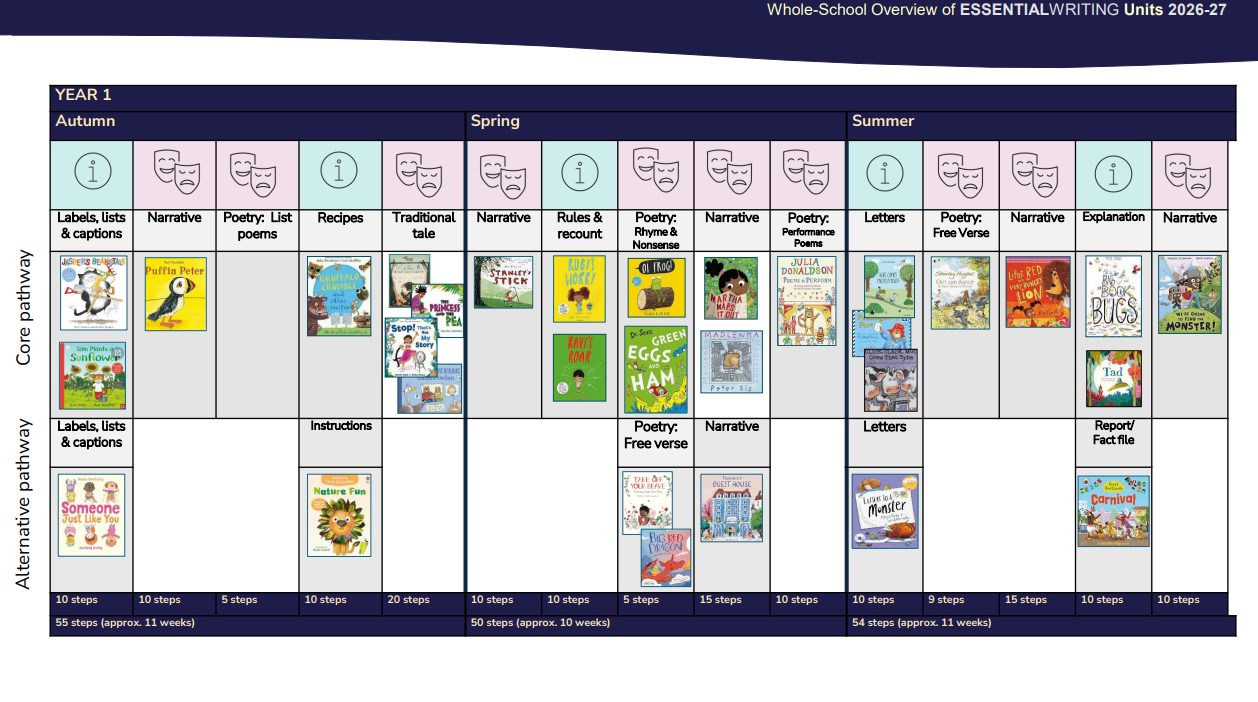
In Year 1, the children are always encouraged to write for an authentic audience and are introduced to the concept of writing to entertain and to inform their readers. Alongside their growing knowledge of how sounds are represented in writing (grapheme-phoneme correspondence, or GPCs), the children learn how to use this knowledge to write a wider range of vocabulary to support their own compositions. Simple sentence structure is emphasised, along with use of spaces between words, capital letters and full stops, to help the reader know where one idea ends and another begins. The children will also start to extend the range of punctuation applied by using question marks and exclamation marks in their writing. They will become familiar with a range of genres, such as narratives, recipes, letters and explanations, and enjoy playing with language whilst writing their own poetry.
Year TWO
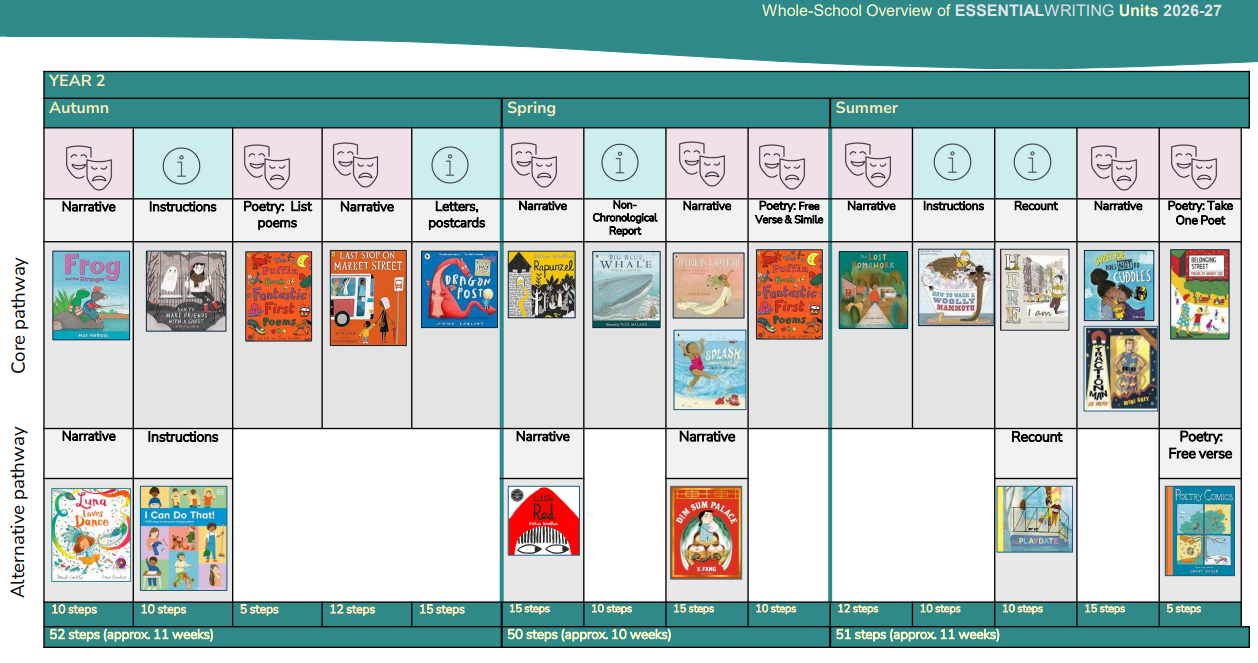
In Year 2, the children build upon their understanding of writing to inform and to entertain their audience. Use of sentence structure is consolidated further, and the children are taught how to join their ideas to create greater variety and interest for the reader. Punctuation to demarcate sentences is regularly taught and reviewed, and the children are introduced to using a comma to separate items in a list and apostrophes to show where letters are missing (contraction) or singular possession. A range of wider vocabulary is taught and encouraged within the children’s writing, to support more detailed description, along with the use of adjectives and adverbs to add detail to nouns and verbs. Children in Year 2 are taught about a wider range of genres to suit their writing purpose, such as a non-chronological report and instructions when writing to inform. To support their understanding of how to entertain their reader, they are also taught about some figurative language techniques, such as the use of simile and alliteration.
In ESSENTIALWRITING lessons, the stages of the writing process are given dedicated teaching time to enable all children to behave as writers. They learn about these vital stages of writing and, within key stage one, they are given time to collect their ideas, plan and compose their writing orally before writing. They are given regular opportunities to share their writing by reading and rereading it aloud. Children regularly discuss what they have written with their teacher and their peers to ensure their meaning is clear. They are taught to proof-read to make corrections in spelling, grammar and punctuation so that their readers can follow their writing with clarity. Vitally, within all writing units, the children are given time to publish their writing to share it and celebrate their success with their intended audience.
As children progress through the writing curriculum, links are made to support the children as they continually build on skills and knowledge that they have accumulated in previous year groups. In the EYFS period of a child’s learning, the children explore mark making and their learning of synthetic phonics enables them to assign meanings to their marks. This moves on to Key Stage 1, where these skills are nurtured and developed further with the introduction of grammar, focused texts and genres to inspire writing and the increase of writing across the curriculum.
Handwriting is a basic skill that influences the quality of work. In the Early Years, print handwriting is taught to ensure correct letter formation is developed. This enables children in Key Stages 1 and 2 to have a secure basis for writing in a neat legible cursive script, with our intention being that handwriting is an automatic process that does not interfere with creative and mental thinking.
Spelling is also taught as this is a key element to being a successful writer; pupils are able to spell the relevant year group spellings, which in Key Stage 1, are closely linked to phonic learning. Initially, pupils are taught to segment spoken words into graphemes before moving on to learning more spelling rules and different word families.